FIRST SPECIALIST VISIT · 2024
36%
Waited at least three months
Among adults in the ten provinces who had an initial specialist consultation in the preceding year. Self-reported; people still waiting are not included. [1]

GLOBAL CARE LANDSCAPE · EVIDENCE BRIEF 01
A Careverse™ research series on the workers, businesses and products behind care, with a reproducible framework for studying access and affordability.
About 1 in 9 workers in the ILO’s historical care-economy benchmark. Millions of products across care categories. Workers, businesses, product variants and seller offers are different units.
Medical, pharmacy, personal care, wellness, home, family and pet care: the first brief reviews sources and defines a global research protocol, including geography, classification, duplicate removal and evidence gaps.
October 3, 2026 · AI-assisted evidence synthesis; not independently peer reviewed or a completed global census. No verified 300-million care-product total is claimed. Industry context is not Careverse inventory. Sources and limitations are in the PDF.
OPEN RESEARCH · PUBLISHED BY CAREVERSE™
A 104-page collection on interoperability, agentic systems, administrative automation, navigation, governance, economics and care-flow mathematics. Each asks how more people can obtain appropriate, affordable care with meaningful choice.
Free to read. No sign-up required. Research working papers; AI-assisted and not independently peer reviewed. Sources, assumptions and limitations accompany the analysis.
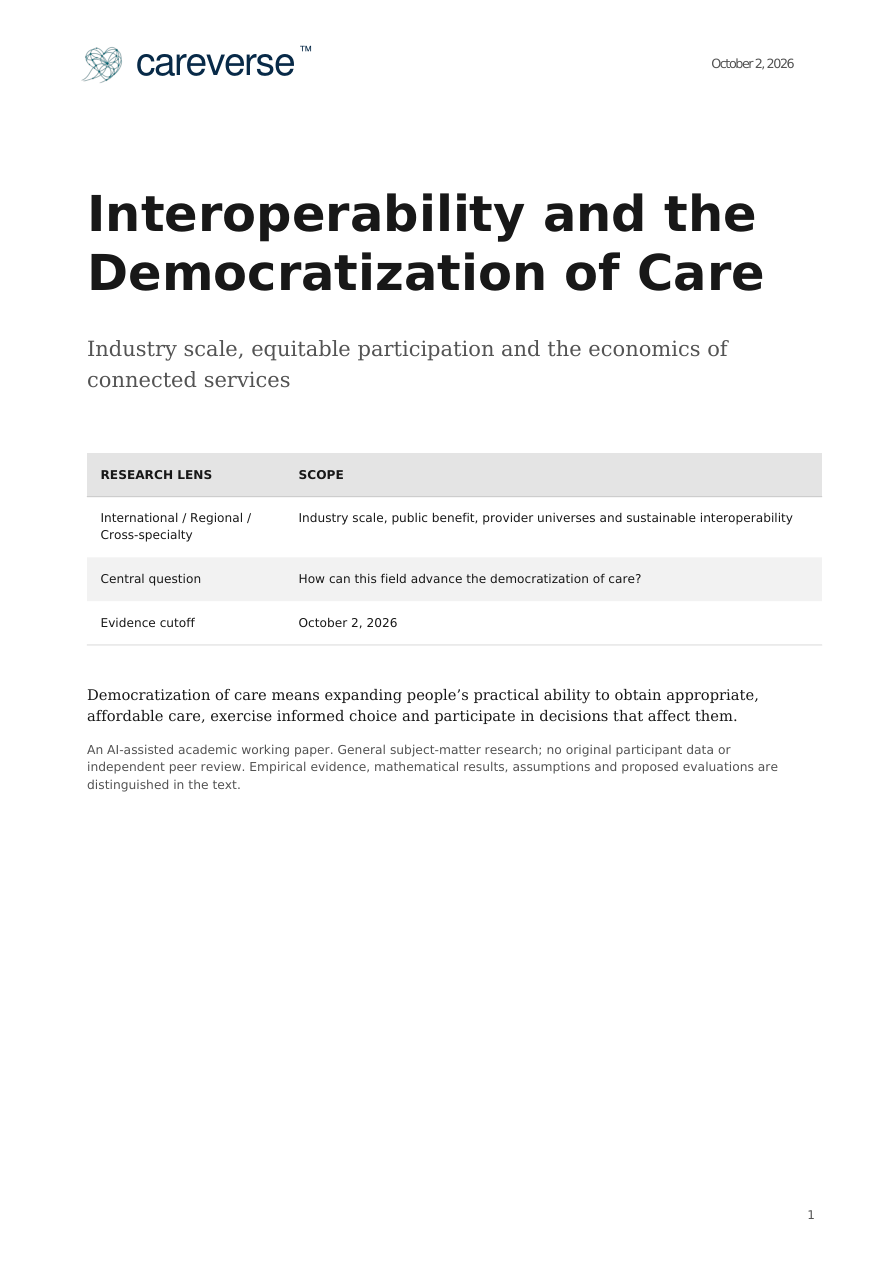
How can connected systems expand access without mistaking industry spending or provider counts for an addressable software market?
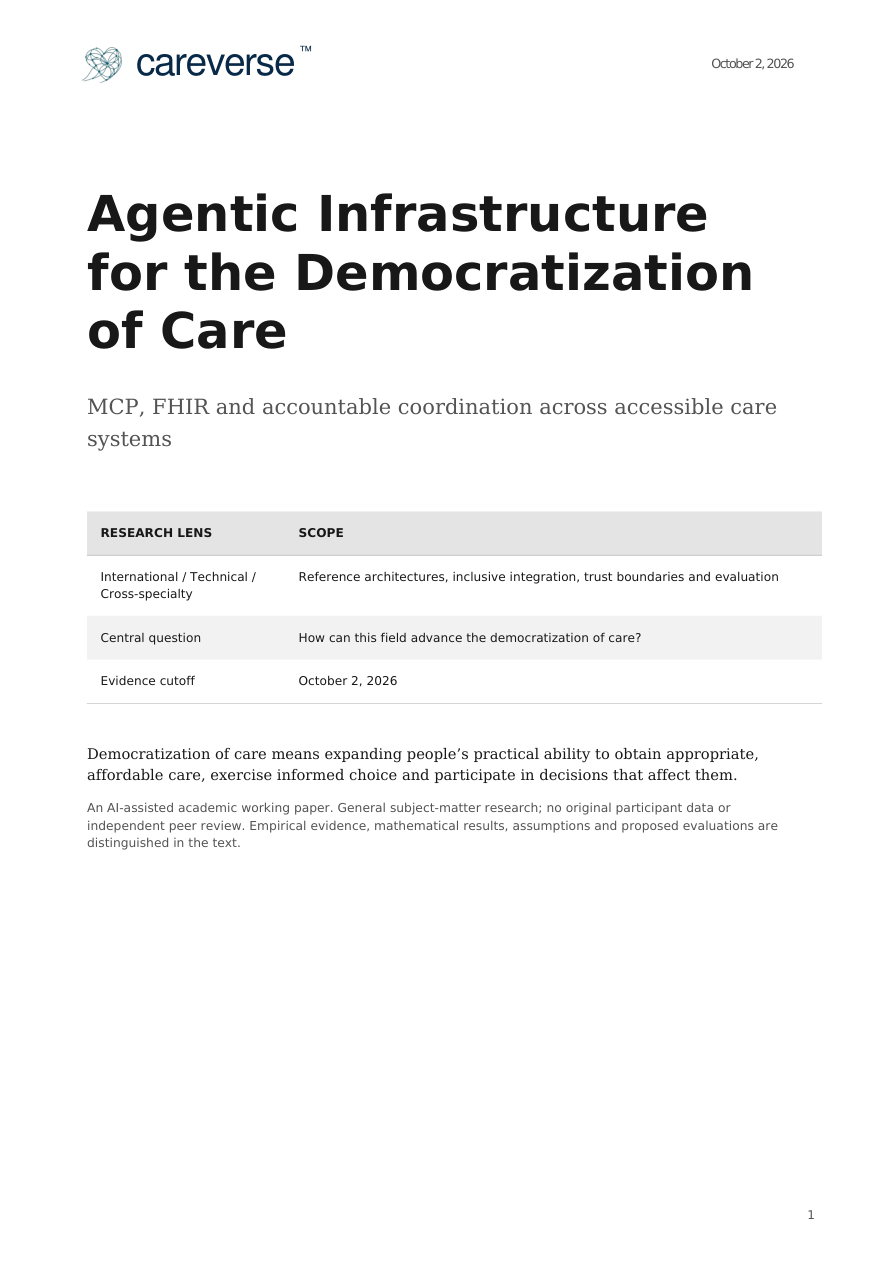
How can programmable agents coordinate care through MCP and FHIR while preserving permission, oversight and practical access?
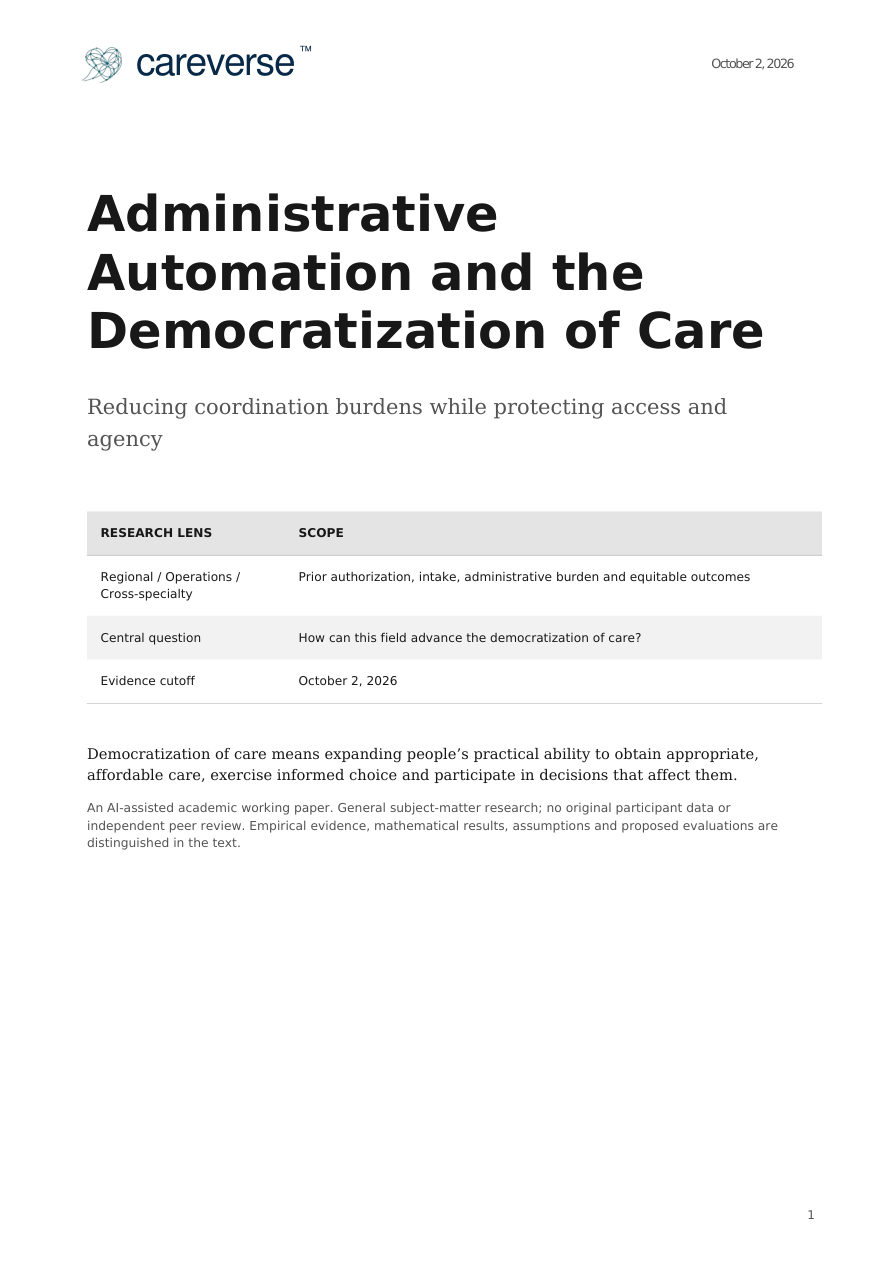
When does automation reduce administrative burden, and when does it move work to patients, clinicians or exception handling?
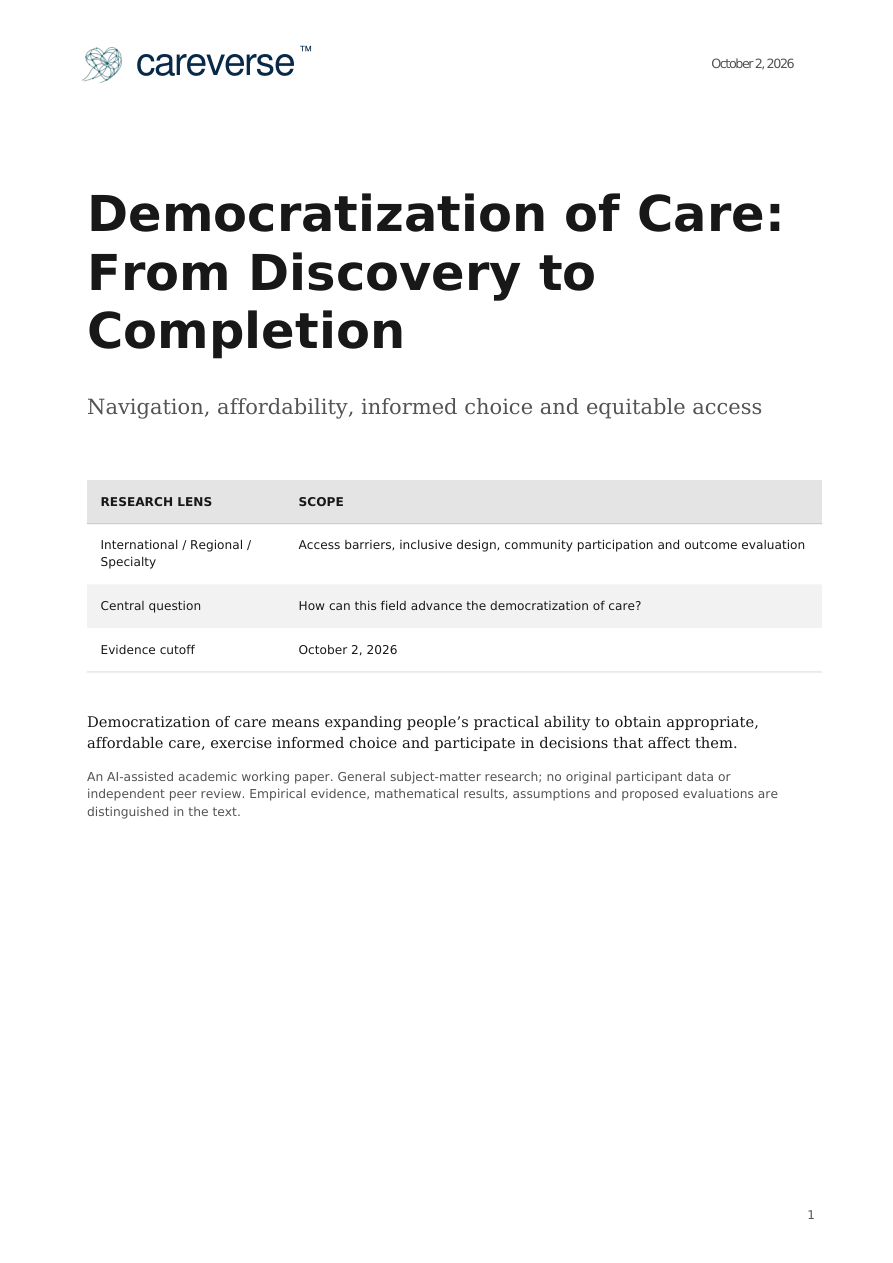
What turns a discovered service into appropriate, affordable, completed care—and how should unequal outcomes be measured?
How can privacy, secure systems and operational rights support meaningful participation in a connected care economy?
Who benefits, who pays and what makes care coordination sustainable without undermining affordable access or informed choice?
What does 1.56 sextillion actually count? A reproducible audit separates hypothetical combinations from feasible pathways and completed care.
THE GLOBAL PICTURE
Compare systems, understand shared challenges and explore evidence that crosses national borders. Start with the interoperability paper, agentic infrastructure paper and care-flow mathematics audit.
Explore health indicators, coverage and disparities across countries.
Explore comparative research on how health systems are organized, funded and assessed.
Find biomedical and life-sciences literature. Assess each study’s methods, population and relevance before applying its findings.
LOCAL CONTEXT MATTERS
Start with a region, then look closer at the country, community and people behind the data. Explore administrative automation, data governance and care economics through their regional context.
Population health, access, health services and national data resources.
Public health, cross-border cooperation, digital health and health-system priorities.
Regional health priorities, access and the diversity of local care systems.
Regional and country perspectives on public health, access and service delivery.
Regional perspectives spanning South-East Asia and the Western Pacific.
Explore country and regional perspectives; geographic groupings vary between research organizations.
Regional groupings are browsing guides. Source coverage and definitions differ; compare like-for-like populations and time periods.
CANADA · PROGRAM RESEARCH
Research notes on 22 public, nonprofit, private and employer-sponsored programs. Compare who qualifies, where a program operates, who administers it and who provides the care.
Updated . Each entry shows its own source-check date from September 26–October 3, 2026. These are external program descriptions, separate from Careverse membership services. Official eligibility, funding, provider and policy rules control; a listing does not establish a partnership or acceptance.
LATEST · Ontario
Funding for basic disability-related home and vehicle modifications, adaptations and assistive devices.
Eligibility: Permanent Ontario residents with a mobility-related disability and financial need. Temporary residents and visitors are excluded. Household income, functional needs and relevant occupational-therapist recommendations are assessed.
Limits: Funding depends on assessed priority and available money. Apply for authorization before buying equipment or starting work; earlier costs are not reimbursed.
LATEST · BC, Alberta, New Brunswick, PEI, Nova Scotia, Newfoundland and Labrador, Yukon
Loans of health and mobility equipment for recovery, independent living and palliative support at home.
Eligibility: A health-professional referral is the standard route. Equipment, delivery, installation and duration depend on the regional program. Basic short-term loans generally cover needs of three months or less.
Limits: HELP is available in seven named jurisdictions, rather than every province and territory. Longer-term, hospital-bed and advanced-equipment routes have separate regional rules; confirm stock and the local referral process.
The official agreement list contains four jurisdictions for selected contraception and diabetes medicines. Each local program has its own formulary and access rules.
Eligibility: Generally requires residence in an agreement jurisdiction, applicable public-health-insurance eligibility, and a valid prescription or authorization. Age, income and private/workplace coverage do not generally exclude an otherwise eligible resident.
Limits: Coverage does not include every medicine or diabetes device. Prescribing and delivery fees may remain. Federal drug-program members keep their existing program coverage.
Launched March 1, 2026, with 100% coverage of selected diabetes medications, contraceptives and menopausal hormone therapy.
Eligibility: Provincial health and drug-coverage eligibility applies. A valid prescription is filled through the B.C. pharmacy/PharmaNet route; some products need Special Authority.
Limits: Full-payment rules apply to covered Plan NP prescriptions. Pumps, glucose monitors and other diabetes supplies have separate criteria. Check the exact product and covered alternative.
Listed birth-control, diabetes, HIV and hormone-replacement medicines are covered under a named provincial program. The earlier birth-control and HIV medication programs are legacy components.
Eligibility: An active Manitoba Health card and Manitoba Pharmacare eligibility are required; 100% coverage through certain other public programs affects eligibility. Private insurance does not itself exclude a person.
Limits: Coverage depends on the formulary, lowest-cost interchangeable product, professional-fee rules and special authorization. Device programs remain separate.
Listed diabetes medicines and contraceptives have been covered at no cost since May 1, 2025.
Eligibility: PEI residents need a valid PEI Health Card and an included prescription filled at a community retail pharmacy in PEI. Medication coverage is automatic.
Limits: Brand differences and special authorization may apply. Blood-glucose strips follow a separate enrollment, copay and quantity-limit route; out-of-province fills and retroactive coverage are excluded.
Launched April 15, 2026, for listed contraception and diabetes medicines, with a linked insulin-pump expansion.
Eligibility: Eligible Yukon residents with Yukon Health Care Insurance Plan coverage are automatically enrolled. Specified federal drug-program beneficiaries use their federal coverage.
Limits: Use a Yukon pharmacy. Formulary, lower-cost alternative, special-authorization and supply-limit rules apply. Do not assume all diabetes devices, supplies or GLP-1 medicines are covered.
An income- and family-size-based program for eligible formulary medicines, supplies and services, with no registration fee.
Eligibility: Nova Scotia residency, a valid health card and income/family-size information are required. Enrollment in certain other provincial drug programs excludes this route.
Limits: Deductibles and copayments may apply; benefits renew April 1. This program is separate from the four federal national-pharmacare agreements.
Assistance when eligible prescription costs are high relative to household income.
Eligibility: A valid Ontario health card and household application are required. The program generally applies when drug costs are about 4% or more of after-tax household income and insurance does not pay all costs.
Limits: An income-based deductible applies. After it is met, a copay of up to C$2 per eligible prescription may remain. Coordinate private coverage and check the formulary or Exceptional Access approval.
A combined senior program for eligible pharmacy, dental, vision, hearing and equipment benefits.
Eligibility: Yukon health coverage and residence, plus age 65+, or age 60–64 and married to a Yukon resident aged 65+, are required. New residents have a three-month waiting period.
Limits: Other insurance is used first. Benefit limits, prior approval and residency/absence rules apply; pharmacy, dental, vision and hearing components have different conditions.
Income-qualified seniors can have the annual deductible waived and pay up to C$2 per eligible prescription.
Eligibility: For the August 1, 2026–July 31, 2027 benefit year, the reviewed official notice sets income ceilings of C$25,480 for a single senior and C$42,290 for a couple.
Limits: Apply through the official program and verify household category, benefit year and covered medicine. Research used official indexed text; direct page/PDF retrieval was restricted, so consult the full current application before relying on enrollment details.
Public dental coverage with service and cost-sharing rules.
Eligibility: Canadian tax residency, required tax filings, adjusted family net income below C$90,000, and no access to private dental coverage are central tests.
Limits: Access to private coverage matters even when someone chooses not to enroll or use it. Narrow exceptions and coordination with public social programs exist. Covered treatment is not always free.
Eligible routine dental services for qualifying low-income seniors; prosthetics have separate partial-coverage rules.
Eligibility: Ontario residents aged 65+ meeting current income limits and other-coverage criteria. Current reviewed guidance uses C$25,480 single / C$42,290 couple and allows CDCP coverage as an exception to the other-benefits restriction.
Limits: Apply provincially, then use the local delivery route. OSDCP and CDCP have separate rules; dual enrollment does not authorize double billing. Provincial indexed text and York Region guidance were reviewed; the exact income-change effective date was not established.
Eligible pharmacy, dental, vision, mental-health counselling, medical equipment and medical-transportation benefits for qualifying First Nations and Inuit clients.
Eligibility: Client status and benefit-specific criteria apply. Other provincial, territorial, employer, private or public coverage is generally used first where applicable.
Limits: Prior approval, benefit lists, frequency limits and direct-billing arrangements differ by category. A listed category does not establish full payment for every item or provider.
Temporary health coverage for specified eligible foreign-national groups; benefit level depends on status.
Eligibility: Confirm current IFHP eligibility and coverage type with a registered provider. Basic physician and hospital benefits remain fully covered under the reviewed rules.
Limits: From May 1, 2026, eligible prescriptions generally carry C$4 per fill/refill and eligible supplemental services/products generally carry a 30% copay. This includes many dental, vision, counselling, home-care and equipment services.
Approved funding to purchase home-care services or employ providers, with management and reporting responsibilities.
Eligibility: Assessment and a service plan are required. Named groups include children with complex medical needs, adults with acquired brain injury, eligible home-schooled children and assessed extraordinary circumstances.
Limits: The patient or substitute decision-maker must meet management requirements. Contact the care coordinator for the approved scope; this is not unrestricted caregiver cash.
Assessed funding for home and community supports such as personal care, housekeeping, meals, nursing, transport and home adaptations.
Eligibility: Qualifying VAC status, residence and assessed need determine access. Survivor and primary-caregiver pathways have their own narrower rules.
Limits: Funding works with other public programs, is subject to approved services and amounts, and is unavailable while residing outside Canada. Regulated care requires appropriately regulated providers.
Individual or couples therapy by phone/video, with separate introductory consultations and self-guided Digital CBT.
Eligibility: A GreenShield insurance policy is not required to create an account and use the service. Check clinician licensing and suitability for the person’s location.
Limits: Therapy is paid; introductory consultations and self-guided CBT are distinct offerings. Confirm the current rate and any benefit-plan reimbursement before booking.
A distinct program offering free virtual therapy and a one-year Digital CBT subscription to eligible women.
Eligibility: The reviewed program summary describes women aged 18+ living in Canada. Confirm current allocation and registration capacity.
Limits: Do not apply a partner-specific therapy-hour allowance to every applicant or assume all GreenShield therapy is free.
Health and travel-insurance choices after group coverage is lost, with separate premiums and policy terms.
Eligibility: The reviewed page describes Canadian residents with an email address, aged 50–74 when group coverage is lost, whether retired or not. The stated absence of a termination age is different from entry-age eligibility.
Limits: Verify enrollment deadline, carrier, administrator, coverage schedule and travel conditions from current documents. Standalone life coverage is outside this care research.
Consolidated access to employer-selected health and well-being services.
Eligibility: Access depends on the sponsoring employer and selected services. Online availability does not establish clinical availability in every country.
Limits: Keep this Canadian digital well-being offering distinct from the U.S. Marketplace 365+ administration solution acquired by Aptia. Confirm the exact product name and employer documents.
A paid emergency-medical travel policy with an assistance service.
Eligibility: Provincial/territorial health coverage and policy eligibility apply. Health exclusions, stability requirements, trip dates and destination must be reviewed.
Limits: Read the current certificate for the issuing insurer, assistance administrator, limits and contact-before-treatment obligations. The research listing excludes baggage, cancellation and generic travel perks.
Research scope: Program summaries support comparison and further investigation; they are not enrollment decisions. The Ontario Assistive Devices Program visual-aids candidate remains outside this collection pending fuller verification. Provincial programs and private policies can change between check dates. Explore Careverse Canada.
THE MANY DIMENSIONS OF CARE
Explore clinical specialties and the everyday services that help people live, recover and care for others. The navigation and equity paper offers a framework for evaluating access across different care pathways.
Prevention, continuity, cardiometabolic health and long-term conditions.
Mental health, substance use, emotional well-being and access to support.
Oral health, eye care, hearing and access to essential sensory services.
Maternal health, reproductive health, pediatrics and family care.
Healthy aging, home care, disability support and caregiver experience.
Recovery, mobility, nutrition, physical activity and independent living.
Medication access, pharmacy services, testing and assistive technology.
Connections between human, animal and environmental health.
Specialty links open topic searches in PubMed. Search results are not individually reviewed or endorsed by Careverse™.
QUESTIONS THAT CONNECT EVERY CATEGORY
Follow a question across regions and specialties—from access and affordability to the next generation of care technology.
Affordability, wait times, rural access, language and the barriers between people and care.
Agentic systems, clinical evaluation, human oversight, connected records and workflow integration.
Market research, cost of care, workforce capacity, operational burden and sustainable delivery.
Patient safety, data governance, consent, accessibility and responsible use of technology.
RESEARCH WITH PURPOSE
Researchers, universities, clinicians, community organizations and developers are welcome to suggest a source, share a publication or discuss a research opportunity.
Connect about research ↗